Love Leadership by John Hope Bryant
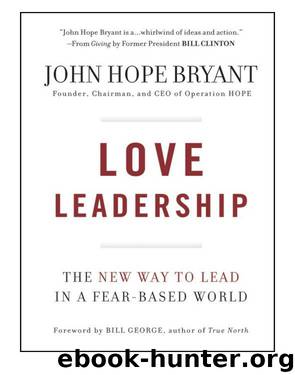
Author:John Hope Bryant
Language: eng
Format: epub
Publisher: Wiley
Published: 2010-05-20T04:00:00+00:00
Our strategy is driving controlled, profitable, market share growth by building lasting relationships with customers and clients. Our vision is to help our customers achieve financial success. All the decisions we made in the subprime arena were totally aligned with this vision.
Wells Fargo chairman Dick Kovacevich was CEO as well during this time, and remembers clearly his tough line of questioning and his eventual decision to back up his team’s decision. He knew the bank could have sold these kinds of bad loans and profited handsomely. But he chose not to become this kind of lender.
He backed Heiden’s insistence that the company articulate its responsible lending principles for nonprime residential real estate lending so that everyone in the company knew them and lived them. Wells Fargo is a company where people feel empowered to make decisions, but these decisions are rooted in the company’s vision and values “Bible” that goes out to every team member in every branch. Heiden’s team added a section on “responsible lending” that said Wells Fargo would only approve an application when the company believed the borrower had the ability to repay the loan.
“And that protected us from this fiasco,” Kovacevich told me. “We didn’t do this, because in the long run we would have lost more money than we would have gained. Of course we shouldn’t lend to someone who we know isn’t going to be able to afford a loan, even if you can sell it to somebody else, because in the long run it’s going to hurt us.”
In the end, everyone won. The customers got better loans, the salespeople were reasonably compensated on loans that would not come back to haunt them, and the bank developed new relationships with appreciative new customers. Word of Wells Fargo’s integrity spread throughout the industry.
Wells Fargo’s love leadership showed that it was more concerned about a long-term win-win relationship with its customers than a short-term, potentially win-lose transaction with a one-time borrower.
Kovacevich emphasizes that the company’s culture ultimately guides difficult decisions like these. By “culture” he means something more wide ranging that most companies: culture determines how the company’s employees behave every day, and how they treat each other and their customers.
We believe so strongly in culture that we will not hire anybody, buy anybody, do a joint venture with anybody, unless we believe that the culture of that person or entity is compatible with us. For instance, when all the commercial banks in the 1990s were buying investment banks, we did not. It’s not that investment banking wasn’t a business. You could make money. It wasn’t because our customers didn’t want investment banking. It’s that the cultures were incompatible. They were short-term oriented.
Download
This site does not store any files on its server. We only index and link to content provided by other sites. Please contact the content providers to delete copyright contents if any and email us, we'll remove relevant links or contents immediately.
Hit Refresh by Satya Nadella(9101)
The Compound Effect by Darren Hardy(8901)
Change Your Questions, Change Your Life by Marilee Adams(7715)
Nudge - Improving Decisions about Health, Wealth, and Happiness by Thaler Sunstein(7676)
The Black Swan by Nassim Nicholas Taleb(7084)
Deep Work by Cal Newport(7028)
Rich Dad Poor Dad by Robert T. Kiyosaki(6568)
Daring Greatly by Brene Brown(6485)
Principles: Life and Work by Ray Dalio(6369)
Playing to Win_ How Strategy Really Works by A.G. Lafley & Roger L. Martin(6166)
Man-made Catastrophes and Risk Information Concealment by Dmitry Chernov & Didier Sornette(5977)
Digital Minimalism by Cal Newport;(5733)
Big Magic: Creative Living Beyond Fear by Elizabeth Gilbert(5721)
The Myth of the Strong Leader by Archie Brown(5479)
The Slight Edge by Jeff Olson(5391)
Discipline Equals Freedom by Jocko Willink(5351)
The Motivation Myth by Jeff Haden(5188)
The Laws of Human Nature by Robert Greene(5126)
Stone's Rules by Roger Stone(5065)
